Hospital price transparency
What true, accurate and complete commits you to
Three words do the work in the affirmation: true, accurate, complete. They are qualified by knowledge and belief, but they are not decorative. Each maps to a failure mode a reviewer can find.
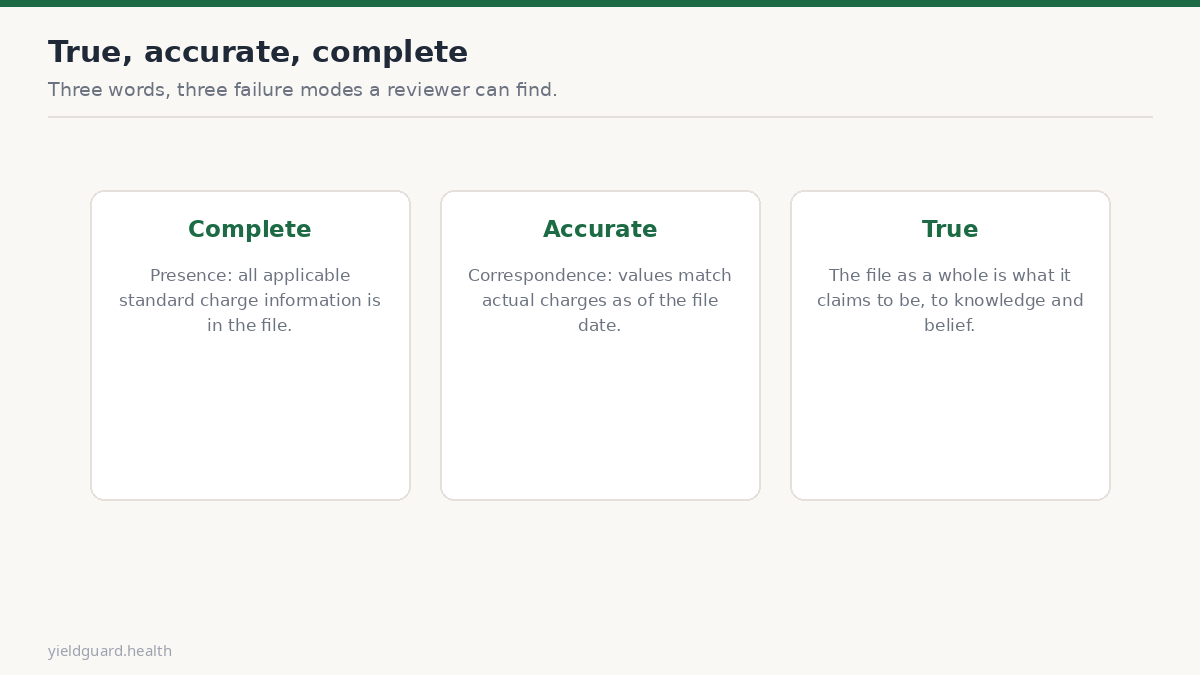
Complete is about presence: all applicable standard charge information is in the file. Missing negotiated rates, absent service lines and skipped charge types are completeness failures - and they are the kind an automated comparison against contracts or a charge master can surface.
Accurate is about correspondence: the values encoded match the hospital's actual standard charges as of the file date. Accuracy fails quietly - a rate that changed in January and a file refreshed in March was accurate at posting and stale by summer, which is why the as-of date matters.
True is the umbrella: the file as a whole is what it claims to be. The knowledge-and-belief qualifier is not a loophole; it is a standard about what the hospital knew and what it should have checked. A hospital that never samples its own file will struggle to explain its belief.
Legal counsel should read the affirmation as the hospital's public position on its own data, signed by name.
Sources
Related guides
YieldGuard audits hospital machine-readable files against the current CMS requirements. Request Compliance Assessment