Hospital price transparency
What the CMS attestation is
Since January 1, 2025, every hospital machine-readable file has been required to carry a statement about itself. The CY 2024 OPPS/ASC final rule added the affirmation: a statement, encoded in the file, that the hospital has included all applicable standard charge information and that the information displayed is true, accurate and complete as of the date in the file. The CY 2026 OPPS/ASC final rule then modified the affirmation - strengthening its language on payer-specific negotiated charges and requiring the file to name the senior official who stands behind it - effective January 1, 2026, with CMS delaying enforcement of the new requirements until April 1, 2026.
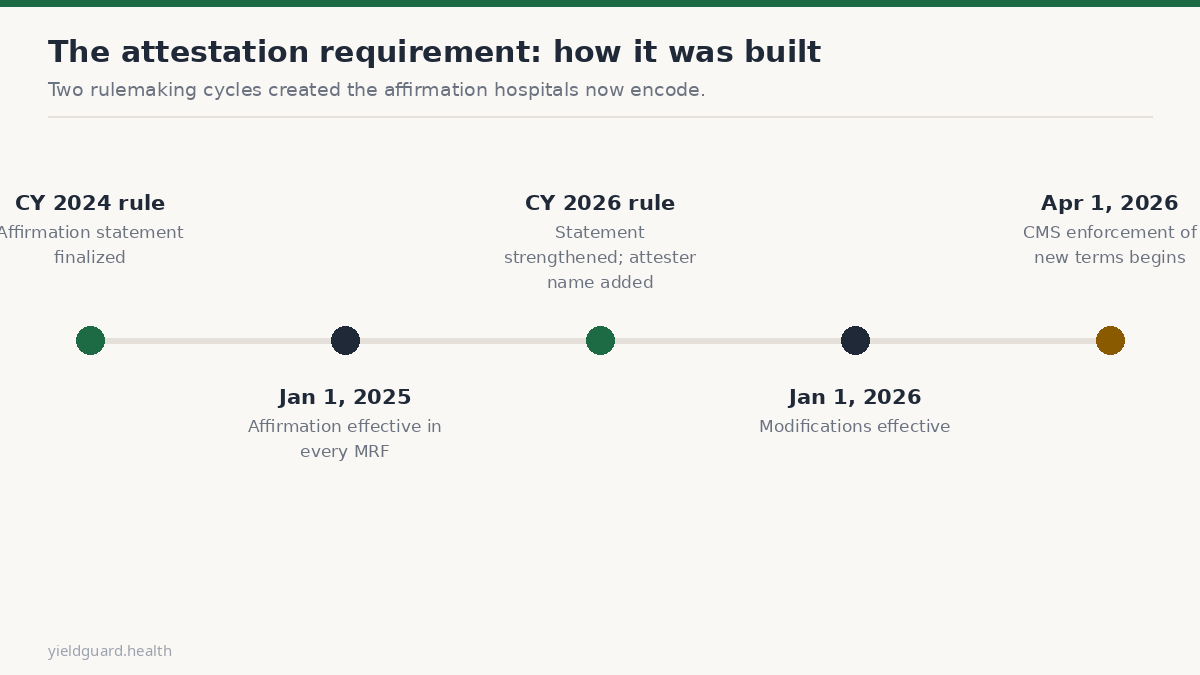
The attestation lives inside the file, not beside it. In the CMS schema it is an attestation object: the statement text, a confirmation value, and the attester's name, encoded alongside the charges they describe. Every copy of the file, downloaded by anyone, carries the hospital's own statement about the file's quality.
This shapes what posting a file means. Each update republishes the data and renews the statement about that data in the same act. A team that treats the affirmation as a formality is confirming something it has not read.
The rest of this cluster walks the requirement in detail: the exact language, who signs, where it appears, when it refreshes, and the mistakes to avoid.
Sources
- CMS: Hospital Price Transparency FAQs
- CMS: HPT technical documentation
- CMS: Hospital price transparency fact sheet
Related guides
- The attestation language, word for word
- Who should sign the attestation
- What true, accurate and complete commits you to
YieldGuard audits hospital machine-readable files against the current CMS requirements. Request Compliance Assessment